
In a conventional off-grid solar system, batteries usually store energy and balance the difference between power generation and consumption. However, for applications where electricity demand is concentrated during the daytime and the load is relatively stable, batteries can also add substantial purchasing, installation, maintenance, and replacement costs.
With the development of wide-voltage off-grid inverter technology, solar systems can now be configured more flexibly. When the technical conditions are met, electricity generated by the PV array can be supplied directly to the load, reducing reliance on the battery-storage stage.
Giving Priority to the Load
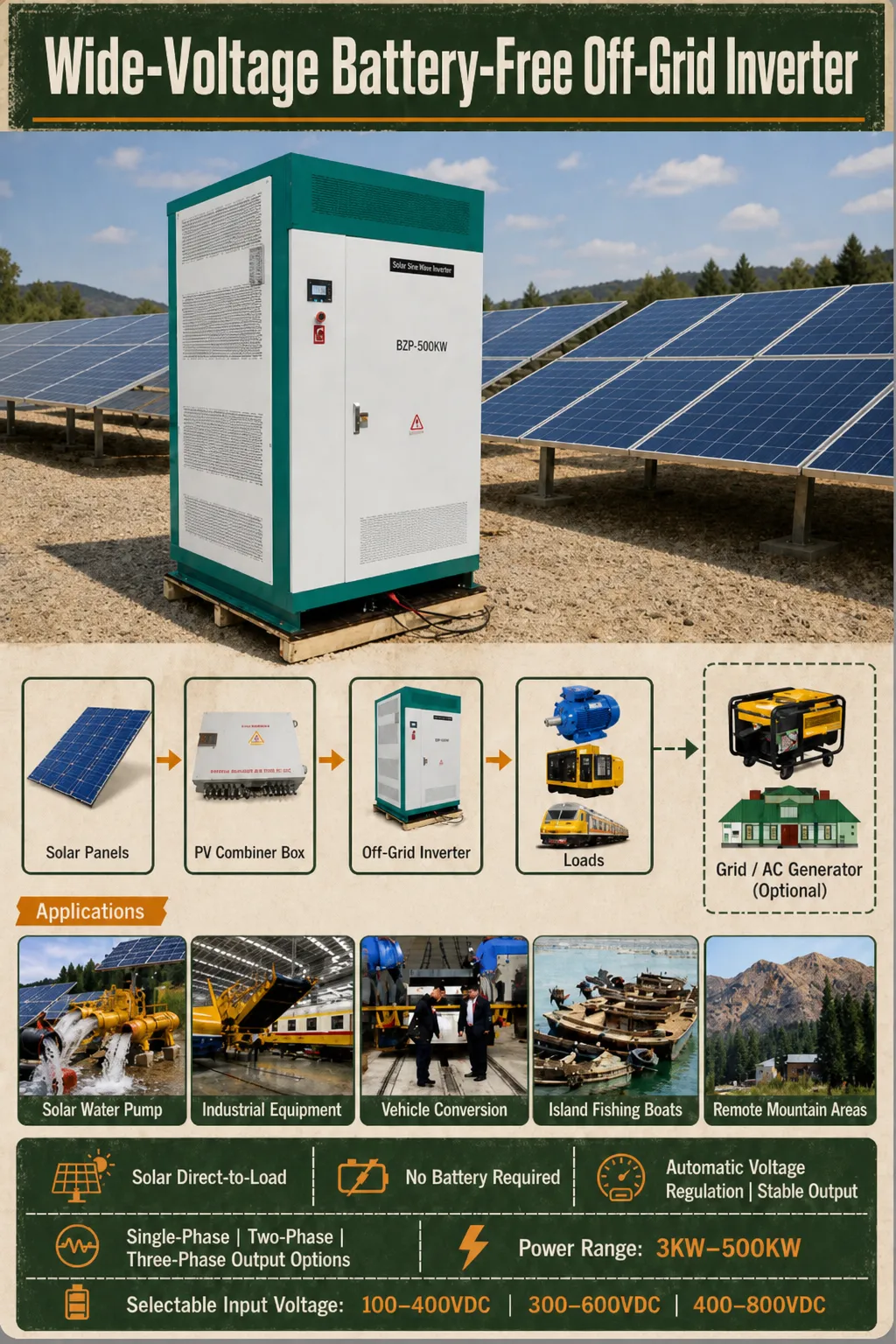
One of the key benefits of a wide-voltage off-grid inverter is that it allows solar power to reach the point of use more directly. When sunlight is sufficient and PV input power can meet the load demand, the system can prioritize solar generation for equipment operation and reduce the intermediate process of “solar generation—battery charging—battery discharging—load consumption.”
For water pumps, fans, ventilation equipment, production-support equipment, and other loads that operate during the day, this approach can improve the immediate utilization of solar power and reduce the required battery capacity.
Wide-Voltage Input for More PV Configurations
The number of PV modules, string arrangement, operating voltage, and on-site solar conditions vary from project to project. A wide-voltage input design gives system designers greater flexibility. Within the product specifications, it can accommodate PV arrays with different sizes and voltage ranges.
This does not mean that the inverter can operate beyond its rated input limits. During system design, the PV array must be checked against the inverter’s open-circuit voltage, maximum-power-point voltage, operating current, and the minimum local temperature. The array must remain within the inverter’s permitted input range under all relevant conditions.
The Practical Value of a Battery-Free Configuration
Omitting the battery can first reduce the initial investment in the battery bank and associated charging equipment. It may also reduce the need for battery cabinets, additional cabling, ventilation, protection systems, and periodic maintenance. For projects that do not require nighttime power and whose loads are mainly concentrated during daylight hours, this lightweight configuration can offer clear economic value.
However, projects that require continuous nighttime operation, backup power during cloudy weather, or support for loads with high starting currents and significant fluctuations may still need batteries, a backup power source, or another form of energy-management solution. System design should be based on the actual load profile and the required level of power reliability.
Suitable Applications
Wide-voltage off-grid inverters can be considered for applications such as:
- Solar-powered water-pumping systems that operate during the day;
- Agricultural irrigation and ventilation loads in livestock or aquaculture facilities;
- Daytime lighting and auxiliary power in remote areas;
- Lightweight off-grid projects seeking to reduce storage investment;
- PV-direct power supply for production equipment or on-site auxiliary equipment.
Conclusion
Wide-voltage off-grid inverters are creating more options for solar self-consumption—from a system that must depend on batteries to a system that can be selected according to the load characteristics. For projects with well-defined daytime demand and a good match between PV generation and the load, battery-free operation may simplify the system, reduce the initial investment, and improve the direct utilization of solar power.
FAQ
Q1: Can the system continue supplying power at night without batteries?
Normally, PV modules cannot provide continuous power in the absence of sunlight. If nighttime loads are required, the system needs batteries, a backup power source, or another available supply method.
Q2: Are all loads suitable for direct PV power supply?
No. Load power, starting current, operating hours, and power fluctuations must be assessed, and the inverter must be confirmed to have the required load-driving capability.
Q3: Does a wide-voltage input mean that PV modules can be added without limitation?
No. The series and parallel configuration of the modules must comply with the inverter’s maximum input voltage, current, and power requirements.